
Findings from the latest wave of the Association for Cultural Enterprises Commercial Performance Barometer suggest June was a particularly difficult month for admissions, particularly in areas of the country worst hit by heatwaves.
Based on a record 182 submissions, key findings are:
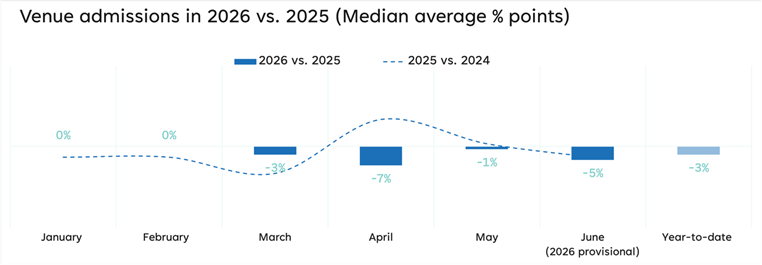
- June admissions down 5% on 2025 with year-to-date visits down 3%
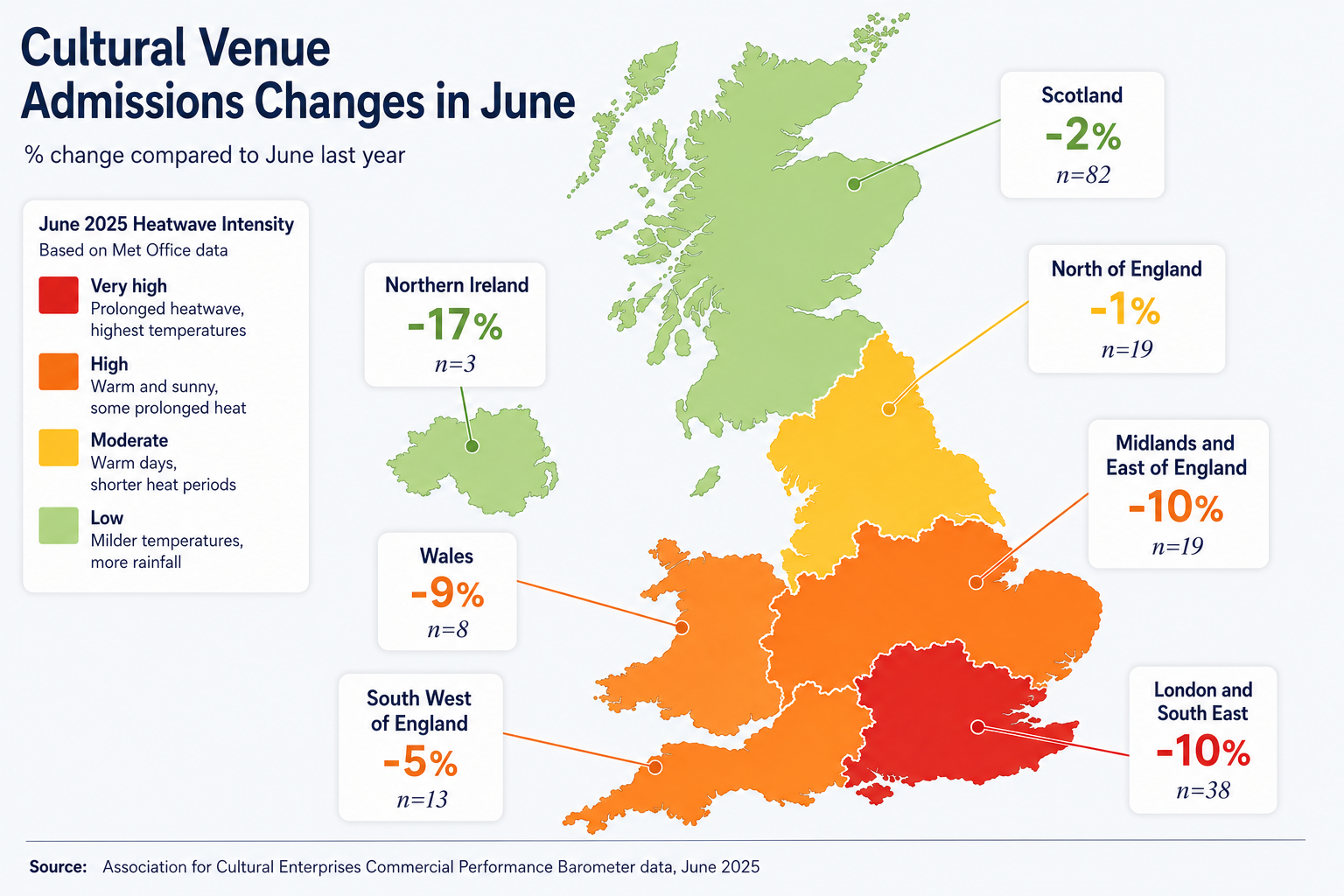
- Admissions correlate strongly with heatwaves – London and South East admissions down 10%, compared to Scotland down 2%
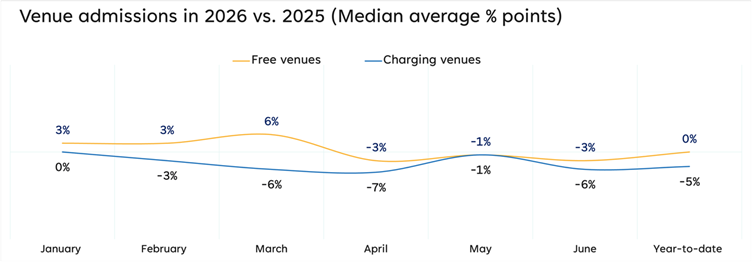
- Indoor venues did slightly better, although gains were only marginal
- Retail and catering continue to offset low admissions – SPV above inflation for both
- Strong commercial programming drives up visits for some
Key findings
June admissions were 5% down on 2025 and 3% down year-to-date, making it the fourth consecutive month of decline this year.
More positively, retail and catering spend per head (SPV) continue to perform above inflation (retail +5% and catering +4%), helping to offset losses at the gate.
Heatwaves add pressure
As illustrated in the map below, there was a stark correlation between high temperatures and the level of decline in June admissions.
London, South East England and the Midlands (worst hit by the heat) experienced a 10% drop in admissions, compared to a 2% fall in Scotland and 1% in the North of England (both relatively less hard hit). Wales and the South West – which sat somewhere in between these temperature extremes – also experienced big falls in visitors. In Northern Ireland, the falls in admissions may have been attributed to ‘pleasant’ (rather than overbearing) temperatures (making trips to the beach more appealing), alongside other factors such as media reports on social unrest and large-scale events competing for the leisure pound.
The impact of the weather came across very strongly in Barometer commentary. 44% of submissions cited it as the main negative driver of performance (the highest to date), and just 9% positively. Numerous venues indicated that they were forced to close their venues on hot days, and for some the impact continued as indoor spaces took time to cool down. Venues with air conditioning may have experienced some benefit, but this was hindered by travel disruption, advice to stay at home, and schools closing.
“Due to an absence of climate control infrastructure, such as air conditioning, we had to close the gallery for the first time due to high temperatures. This means we have lost five days of retail income, making it the worst June for retail income that we’ve experienced since Covid.”
“We were forced to cancel five performances due to excessive heat.”
“Even as an indoor venue with air conditioning we took a hit for three days due to extreme heat, much of it due to travel disruption and advice not to travel by train.”
“The heatwave will not be a surprise to people in these comments. We saw less visitation overall due to the heat, despite making the most our of our water play and air conditioning. School closures have meant that trips didn’t happen and have been moved to alternative dates.”
“Even on days where the temperatures are slightly cooler, in the high 20s, the interior spaces are still extremely hot and push 30 degrees. For staff and visitor welfare, in this period we have had a number of days of full closure due to the heat, and we have also had days where we take off pre-sale tickets, only dealing with walk-up visitors, which allows staff avoid being in the hall for prolonged periods of time. This has also had an impact on retail and catering sales.”
Cost-of-living continues to play a role
Of course it’s not just the heat that is making things difficult for the sector. June continued a trend of charging venues suffering more than free venues this year (see chart below), and global instability continues to impact overseas tourism. Spare a thought for a London tourist attraction that charges for entry and is without air conditioning.
Programming saves the day for some
As always there are some silver linings, with commercial programming having a positive influence once again. The Ashmolean and Somerset House (both in heatwave-hit London and South East), highlight that people will continue to visit if there is a compelling and time-sensitive reason to do so.
“Our exhibition programme this year continues to perform well. In Bloom is a popular exhibition with strong ticket sales and footfall and this is driving positive results for both catering and retail shop spend.” (Ashmolean)
“A number of reasons [explain our positive admissions]. The M. C. Escher exhibition (presented by Fever) in Embankment Galleries has generated huge appeal and a notable direct increase in footfall.” (Somerset House)
National Museum Cardiff also reported positive figures thanks to their Gwen John exhibition and The Museum of the Moon installation.
Conclusion
In summary, it’s been a very challenging June for cultural venues in some parts of the country. With heatwaves unlikely to go away, climate planning (and perhaps winter programming) continue to grow in importance. Fingers crossed for a more positive July and August.
Discover More
Members can learn much more via the Commercial Performance Barometer online dashboard where you can search by sub-group and merge months. You can also read examples of best practice in the sentiment dashboard – please do check out both links.
Listen to the latest episode of the Arts & Culture Podcast in which an expert panel discuss how commercially aligned programming can increase overall financial resilience.
For more information about the monthly Commercial Performance Barometer please contact tom@culturalenterprises.org.uk or jon.young@decisionhouse.co.uk
